Posts

Showing posts with the label Tactics

Tactics Puzzle

Image
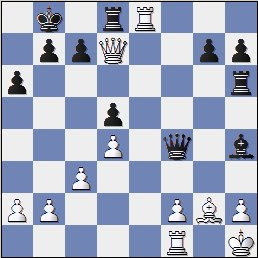
White to move and win Highlight for answer:[ Khalifman-Ulibin, Sochi 1989 1 Nxe6!! Qxe6 2 Re1 Qe1+ (2...Ne5 3 Nxc5; 2...Qf7 3 Re7) 3 Qe1 Bb7 4 Qe6+ ... 1-0 ]

Tactics Puzzle

Image
Black to move and win

Tactics Puzzle

Image
Find the correct winning continuation for Black. Answer tommorrow.

Tactics

Image
BLACK TO MOVE AND WIN Highlight below to see solution:[ Levitt (2455) - Martin,A (2420), Great Britain (ch) 1...Be2!! 0-1 ]
Image
White to move and win. Black appears to have all the bases covered in this nice tactical shot.

The Importance of Being a Good Tactician

Here at the Chess Training Blog, we like to think that we can, in some small way, help sub-2000 chess players improve their game by helping them focus on the weak areas of your game. Invariably, this leads us to Tactics. Books have been written (Rapid Chess Improvement, for one) on how to construct a training program to improve your tactical vision. Often this leads to a deficiency in other areas of your game: Opening Repertoire, Plan Construction, Endgame Play, Strategical considerations, etc. But the reality is, how important are those other aspects of play when compared to tactics, or lack thereof? I've said, and repeated here, the common phrase that 'Chess is 90% tactics'. Some famous GM originated that phrase. Who it is, I have no idea. But the truth still exists within it. One only needs to go back and look over your own games and take note how each game was won or lost by you or your opponent. Were you to write in plain english each critical error, your log would rea...

Theory, Theory, and More Theory

What Is Chess Theory and why is it important? As outlined in a previous post, the GCTS ("Generic Chess Training System") that we are trying to develop here attempts to outline useful self-training methods for each stage of the game as a student progresses. In a recent post, a blogger commented on the lack of Endgame Theory included in the program. Opening and Middlegame 'studies', as opposed to solving problems, make up a fair portion of the program, but there was a lack of endgame study-time alloted. We further went on to elaborate on this missing piece to our chess training puzzle, defending it as being 'included' in the generic Endgame portion of the program. But that does not answer our question: What is Chess Theory? Let's try and define this simply by defining it's components. We all know what 'Chess' is, so: the‧o‧ry   Pronunciation[thee-uh-ree, theer-ee] –noun, plural -ries. 1. a coherent group of general propositions used as principles...