Posts

Showing posts from 2008

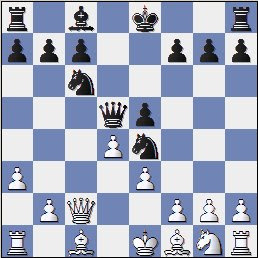
Puzzle

Image
Highlight below with mouse to see solution: [ Keres - Kurajica 11.Qxh6+ Kxh6 2.Nxf7+ Kg7 3.Nxd8 1-0 ]

Pattern Training

Pattern Training is solving hordes of basic chess positions (2-move and three-move mates, to be exact) as fast as you can. This type of puzzle-solving will train your eye to recognize mating patterns with certain combinations of pieces. One of the best books to train this method with has to be "Chess: 5334 Problems, Combinations, and Games" by Laszlo Polgar, father of the Famous Polgar sisters Zsuzsa, ZsĂłfi, and Judit. Start by doing one or two pages a day and increase your solving as much as possible, hopefully getting up to 6 or 7 pages in a day, without too much fatigue. As you progress, you will see that you begin to have 'ah-hah!' moments when you begin to recognize patterns from previous diagrammes already solved. That is a sure indicator that you are progressing in your tactical, mate-solving training.

Chess Training and Improvement

Improvement in chess over years is usually related to the frequency of play and the addressing of discovered weaknesses as a result of your losses. One facet that I have discovered is that people tend to get stuck in a method of so-called 'training' and revert back to that method after a series of less-than-spectacular games played on their part. One tends to 'hunker down' and retrain using the same methods they used previously. The unfortunate thing is that those training methods, whatever they were, led to their current predicament, and are thus flawed in some way, were not executed properly, or did not meet the current needs of the player. One way to address this phenomenon is to make available several different training methodologies to yourself and rotate from one to another. This enriches one's chess knowledge and makes available to the player differing perspectives from some of the great chess teachers throughout history. But what does that mean? Here is a ...

Things You Must Do Every Day To Get Better

Here is a list of chess tasks that should be performed each day if you seek to improve: 1) Review Master Games within your Opening Repertoire 2) Specialization Position Training out of Opening Repertoire 3) Tactics Drills 4) Endgame Studies - R+P(s) vs R+P(s); R+N/B vs. R+N/B; K+P vs. K+P 5) Daily Play - G5, G10, G15. Weekly - At least 1 Standard Time Control Game 6) Review Your Losses! This list covers all aspects of play: Openings, The Middlegame, Endings, Strategy, Tactics, Play and Review of Games. #1 will help you develop a sense of the strategical themes in your choice of openings, and what types of positions to expect from those openings. #2, critical positions taken from #1, will help you understand the strategic elements of the opening/middlegame and the transitions into the endgame. #3 will keep your tactical eye fresh - it can get stale. #4 will naturally improve your ability to finish your opponent off and not fear transitioning into a won endgame from an advantageous middl...

Efficient Opening Study

It's no secret here that I am a Chessbase user, and regularly, on a weekely basis, download new games from Mark Crowther's The Week In Chess, probably the best source of current games in the world. Each Monday I take a few minutes to get the new files and import them into Chessbase 8.0. I recently began reviewing games from the weekly TWIC files in my repertoire, but got tired of setting the filter mask to various ECO codes each time. Out of curiosity, I discovered a really easy method that is virtually instantaneous to gather the games in your customized repertoire for review that I want to share with you. Here is how it works. The first step you do is create a New...Text document in *any* database. Then, using the menu lists, create search masks for each opening that you have in your repertoire. For example, you might like to play the Ruy Lopez: C60 - C99. Create a search mask for ECO codes C60 to C99 and label it "Ruy Lopez - C60 - C99" or maybe something more spec...

Specialization #5

Image
Here is yet another useful position to play against a computer or another like-strength opponent for practice. It derives from the Grand Prix Attack in the Sicilian Defense: 1.e4 c5 2.Nc3 Nc6 3.f4 e6 4.Nf3 d5 5.Bb5 Nf6 6.d3 Be7 7.0-0 Diagram Black to Move [r1bqk2r/pp2bppp/2n1pn2/1Bpp4/4PP2/2NP1N2/PPP3PP/R1BQ1RK1 b kq - 0 7]

Specialization #4

Image
1.d4 d5 2.c4 c6 3.Nf3 Nf6 4.Nc3 dxc4 5.a4 Bf5 6.Ne5 Nbd7 7.Nxc4 Qc7 8.g3 e5 9.dxe5 Nxe5 10.Bf4 Nfd7 11.Bg2 Diagram Black has 2 moves here, and both should be investigated thoroughly for some excellent training: A) 11...f6 B)11...g5

Specialization Position #3

Image
1.d4 Nf6 2.c4 e6 3.Nc3 Bb4 4.Qc2 d5 5.a3 Bxc3+ 6.Qxc3 Ne4 7.Qc2 Nc6 8.e3 e5 9.cxd5 Qxd5 Diagram r1b1k2r/ppp2ppp/2n5/3qp3/3Pn3/P3P3/1PQ2PPP/R1B1KBNR w KQkq - 0 10

Specialization Position #2

Image
D85 1.d4 Nf6 2.c4 g6 3.Nc3 d5 4.cxd5 Nxd5 5.e4 Nxc3 6.bxc3 Bg7 7.Nf3 c5 8.Be3 Qa5 9.Qd2 Bg4 Diagram rnbqkbnr/pppppppp/8/8/3P4/8/PPP1PPPP/RNBQKBNR b KQkq d3 0 1 Specialize the above position for some excellent training. Post any games you played with it here!

Specialization

Image
Today I want to talk about something called Specialization. What is Specialization? Online dictionaries carry the definition as "to pursue some special line of study, work, etc.", and that is the definition we mean for the most part. In our chess-world, we want to 'specialize', or study, a fairly common position in chess. By study I mean deeply analyze and play from both sides for an extended number of times until all facets of the position have been revealed. Let's look at an example straight from the Lev Alburt's book "Building Up Your Chess": Position #1, Black to Move : [r1bq1rk1/p3bppp/1pn1pn2/4N3/3P4/P1NB4/1P3PPP/R1BQR1K1 b - - 0 12] This position can, unbelievably, be reached by a whole slew of different openings ranging from Queen's Gambit Declined to The Caro-Kann to The Scandanavian over to the Sicilian Defense and even the Smith-Morra Gambit! It is great practice on the Isolated Queens Pawn and the attack and defending of such a posit...

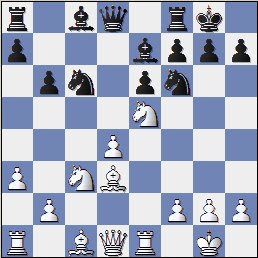
Tactics Puzzle

Image
White to move and win Highlight for answer:[ Khalifman-Ulibin, Sochi 1989 1 Nxe6!! Qxe6 2 Re1 Qe1+ (2...Ne5 3 Nxc5; 2...Qf7 3 Re7) 3 Qe1 Bb7 4 Qe6+ ... 1-0 ]

Idaho Becomes the First to Offer a Statewide Chess Curriculum

Idaho Becomes the First to Offer a Statewide Chess Curriculum as a Strategy for Learning for All 2nd and 3rd Graders SEATTLE, WA--(Marketwire - March 25, 2008) - America's Foundation for Chess (AF4C) today announced that Idaho is the first state to approve the use of the First Move™ chess curriculum in all second and third grade classrooms statewide. "We're thrilled to have the enthusiastic support of the State of Idaho and its school officials who recognize the unique value proposition of chess as an education strategy," said Wendi Fischer, Vice President of America's Foundation for Chess. "We have over 25,000 students using the First Move curriculum across 18 states and the reaction from students, teachers and parents has been outstanding as the benefits extend far beyond the classroom." Teachers in Idaho state schools will have the opportunity to teach the First Move curriculum as part of their standard in-class program. "The reaction to the pilo...

Support Gata's Quest for the World Championship

Image
March 3, 2008 There is nothing more exciting for U.S. chess than Gata Kamsky's run for the World Championship. Later this year, Gata will face former world champion Veselin Topalov of Bulgaria in a match, while current world champion, India's Viswanathan Anand, defends his title against his predecessor, Vladimir Kramnik of Russia. Victory against Topalov will mean a title match for Gata in 2009. Read Gata's own Chess Life annotations from his World Cup win in the March Chess Life Magazine. This will be Gata's third attempt to climb the Olympus of chess. In 1993, the rival organisations FIDE and PCA each held Interzonal tournaments. Kamsky qualified from both, and proceeded to wipe out one top GM after another in the two parallel world championship cycles. As FIDE attempted to establish a successor to the title vacated by the formation of the PCA by Garry Kasparov and Nigel Short, Gata decisively defeated Anand, 6-4 (on the Indian's home turf!), and two others ...

Grand Prix Participants Announced

Today, FIDE has published the list of confirmed participants for the first Grand Prix series. Kramnik, Anand, Topalov and Morozevich are not playing, but still the average rating is above 2700. Svidler Peter RUS 2763 Mamedyarov Shakhriyar AZE 2760 Leko Peter HUN 2753 Ivanchuk Vassily UKR 2751 Aronian Levon ARM 2739 Gelfand Boris ISR 2737 Radjabov Teimour AZE 2735 Carlsen Magnus NOR 2733 Karjakin Sergey UKR 2732 Adams Michael ENG 2726 Kamsky Gata USA 2726 Jakovenko Dmitry RUS 2720 Cheparinov Ivan BUL 2713 Grischuk Alexander RUS 2711 Bacrot Etienne FRA 2700 Wang Yue CHN 2698 Inarkiev Ernesto RUS 2681 Navara David CZE 2680 Gashimov Vugar AZE 2665 Pelletier Yannick SWZ 2600 Al Modiahki Mohamad QTR 2569 Average rating: 2709

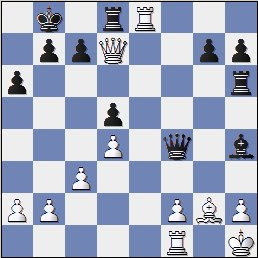
Tactics Puzzle

Image
Black to move and win

King and Pawn endgame

Image
Can black hold or win this position? Black to move.

Fischer Videos

Dick Cavett Interview

Psychology in Chess

The Psychology of Chess Napoleon Hill, well-known author of various personal achievement books like " Think and Grow Rich! ", expounds on some very clear psychological ideas that can be related to chess training in meaningful ways. This article attempts to make some useful correlations between personal achievement and the progression one makes in chess training and performance. Definiteness of Purpose Definiteness of Purpose is the starting point of all achievement. A lack of definiteness of purpose is the stumbling block for about 98% of all people who do not achieve their goals for the simple reason that the never clearly define their goals and start towards them. What does that mean in the context of chess performance and chess training? Performance in modern chess is depicted in the useful ELO rating scale as somewhat a rough indicator. It is, if you will, the 'money' of chess. If, for instance, you are determined, motivated, and obsessed with reaching a rating of...

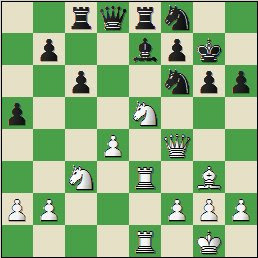
Tactics Puzzle

Image
Find the correct winning continuation for Black. Answer tommorrow.

FIDE Grand Prix Events

Mark Crowther writes for The Week In Chess : The winner of the Grand Prix will play with the winner of the 2009 World Cup for the right to challenge the World Champion in 2010. Each Tournament will be a 14 player all play all. 14 players have the right to compete in the circuit and they have to play 4 of the 6 events (there will be local players too), these will be allocated to them. Below are the details as announced. It will be interesting to see who signs up for this event, my bet is that a number of the top players won't. This was supposed to be a held on different continents but the majority are being held in Europe. Secondly the presence of reserve cities suggests that some of these venues are not certain. Of course there is a certain chicken and egg situation, getting sponsors for the events without the players having signed up will be hard (they could end up with a distinct 2nd string) and the players won't sign up without venues being in place. Things will no doubt be...

Useful Observations

Here are some useful observations for those of you out there trying to complete the Seven Circles tactical training suggested by De La Maza. I not so much discovered these, but rather suffered in their absence. Observation #1: Stay true to the number of puzzles you solve each day AND the amount of time you take to solve them. For example, for the first 64 days, you are asked to solve 16 tactical puzzles each day with the puzzles getting more difficult as the days go by. Now 16 tactical puzzles can be completed in a matter of minutes if they are the garden variety 2-move mates and such. But as you get through your problem set and they become more difficult, you'll find that it takes longer and longer to truly solve the 16 puzzles. My advice is to not fret and have the answers handy to be disclosed to you. This is not *cheating* because, and remember this, you are training your tactical eye, and that is the entire purpose of these drills. It does you no good to sit and dwell over a p...

Is the United States Chess Federation in Trouble?

Is the United States Chess Federation in Trouble? By Dylan Loeb McClain A statement from a meeting about the finances of the United States Chess Federation was posted over the weekend on the federation’s Web forum by Bill Goichberg, the president of the federation. In the statement, Goichberg talked about the federation’s finances, saying they are not in good shape and the federation is projected to run a significant deficit (significant from the federation’s standpoint as it does not have much in the way of financial reserves and its revenues are about $3 million a year). Full Story Here .

The Seven Circles (of HELL)

I have embarked on completion of the Seven Circles of Hell - the tactical marathon recommended by Michael de la Maza in "Rapid Chess Improvement". I do not possess CT-ART 3.0, so I am using a good old-fashioned paperback book to complete this hell race called "Sharpen Your Tactics" by Anatoly Lein and Boris Archangelsky. The book is structured in a manner that the problems start off relatively simple with obvious 2-move mates and increase in difficulty to more complex tactical ideas. The number of problems in the book is 1125 - more than the 1000 that is necessary. They are also all positions taken for real games, yet another requirement met. Why am I doing this? If you saw my blitz play you'd not be asking me that question... In any event, I am also doing the Chess Vision Drills as well. I marked a deck of cards a1 through h8 on one side and the square color on the other side for that drill, as well as doing the Forks and Skewers, Knight Flight, and Pawn Grab ...

Interactive Chess TV - ChessVista

ChessVista News DGT and UEP in Interactive Chess TV 30.01.2008 While Anand and Kramnik were playing their last serious game (Corus Chess 2008, round 13 on Sunday 27 January) before the World Chess Championship Match to be held in October 2008 in Bonn, DGT (Digital Game Technology) and UEP (Universal Event Promotion) have signed a declaration of intent to develop Interactive Chess TV. The signing and the celebration took place in CafĂ© De Moriaan, fifty meters from the Anand vs Kramnik fight, in Wijk aan Zee (Netherlands). The expected amount to invest is ranging from 250 thousand to 300 thousand euro. It is a first next step in bringing chess to the people. ‘We expect to attract a new group of chess public’. DGT and UEP want to broadcast the World Chess Championship Match via Interactive Chess TV. ‘We need a 5000+ audience who on Pay per View basis will be witness of this chess event’. Report by Frits Agterdenbos. Full Article here .

Corus Photos by Fred Lucas

At Chessbase there is a wonderful photo collection from Corus by Fred Lucas. Put some faces to those famous names in the international chess newsreel! Enjoy!

Chinese Invade Gibraltar!

The Chinese have taken over the 6th Gibtelecom Chess Festival. GM's Xiangzhi Bu (5.5/6) and Hao Wang (5/6) currently sit atop the leaderboard after 6 rounds in this strong event. American Hopeful GM Hikaru Nakamura, who lost in round 4 to IM Zong-Yuan Zhao, sits in 24th at 4/6. Live games here .

2008 Gibtelecom Chess Festival

2008 Gibtelecom Chess Festival The 6th edition of Gibraltar's Gibtelecom Chess Festival takes place from 22-31 January 2008 at the Caleta Hotel, one of Gibraltar's best hotels. Live games can be seen here . Several USA players are present, including GM Hikaru Nakamura, GM Varuzhan Akobian, IM Joseph Bradford, and FM Michael Langer in the Masters Section.

A Perfect Tribute to Bobby Fischer

I find the following tribute to Robert James Fischer the single most relevent thing you could ever say about the man, given all the circumstances of his life, his mental illness, and his confrontation with self: Tim Krabbé (Tim Krabbé's Open Chess Diary): If chess is still played ten thousand years from now, Bobby Fischer will be the only player of our times who matters.

Gary Kasparov on Bobby Fischer

With the death of Bobby Fischer chess has lost one of its greatest figures. Fischer’s status as world champion and celebrity came from a charismatic and combative personality matched with unstoppable play. I recall thrilling over the games of his 1972 Reykjavik world championship match against Boris Spassky when I was nine years old. The American had his share of supporters in the USSR even then, and not only for his chess prowess. His outspokenness and individuality also earned him the quiet respect of many of my compatriots. Fischer’s beautiful chess and his immortal games will stand forever as a central pillar in the history of our game. And the story of the Brooklynite iconoclast’s rise from prodigy to world champion has few peers for drama. Apart from a brief and peculiar reappearance in 1992, Bobby Fischer’s chess career ended in 1972. After conquering the chess Olympus he was unable to find a new target for his power and passion. Fischer’s relentless energy exhausted everything ...

Strategic Planning - Knights and bases of Operation

Image
Knights and Bases of Operation Knights like to reside centrally, immune from attack by enemy pawns. A centrally placed knight protected from such attack could be considered as good as a Rook in many positions. In contrast, the poor positioning of a Knight can be an important detriment strategically as the well-placed Knight. Of course, poor-placed pieces naturally seek to improve their standing as soon as possible, but taking advantage of your opponent's misplaced knight is as important a strategic idea as finding squares for your own pieces. Here the great Alekhine demostrates the strategic importance of centrally-placed Knights and the strategic detriment of poorly placed Knights: Here alekhine proceeds to improve his Knight placement methodically with 15...Bxg3 16.hxg3 Ne7 17.b4 Qd7 18.Nc2 Ned5 19.Na3 b5 20.axb5 axb5 21.Qe2 c6 22.Nc2 Qf5 23.Rfc1 h6 24.Ra5 Rec8 25.Na1 Ng4 Diagram And the end came swiftly: 26.Kf1 Re6 27.Rxb5 Rf6 28.Rcc5 Nxf2 29.Ke1 Nd3+ 30.Kd1 Qf1+ 31.Be1 Rf2! Dia...

Strategic Planning - Minority Attack

Image
Let's begin first with a definition of what a Minority Attack is. No - it is not Knights and Bishops ganging up on pawns, or Rooks beating a Bishop back to a1. A Minority Attack is when one side has less pawns on the wing in question and proceeds to advance those pawns in an effort to attack the opposing pawn majority. This is the basic idea behind the Minority Attack. Classical Goals From a purely classical point of view, the Minority Attack was somewhat nonexistent up until the 1920's where mechanical methods mostly decided what strategic ideas were possible in a position. Once the usefulness of the Minority Attack became evident, things changed for both sides. These things were, given the Minority Attack on the Queenside from White's perspective: Weakness of c4, and sometimes e4 When White, the Minority, advances his b-pawn to b4, this leaves a distinctive hole on c4 begging for a Black Knight to come and perch. Black would then strive to: a) exchange the light-squared b...

Robert James Fischer, Dead at 64

On January 18th, 2008, Robert James Fischer, the greatest Chessplayer and Grandmaster the world has ever known, passed away. He was 64. In memoriam, I'd like to post some uTube videos: http://www.youtube.com/watch?v=jR7IWI4Rh1w http://www.youtube.com/watch?v=Ht-OqiuWVMk http://www.youtube.com/watch?v=ZedhMvtsiXI Bobby's Chess was both a boon, in presence, and a bane, in absence, to the world. I am one of the thousands of young chess players in the early 70's to catch fire from this enigma of a man, a hero to me in my youth, living in a suburb of Boston. I keep those memories and do not allow them to mature past the early 70's into something diseased, as it were. His chess will always be remembered by me, and nothing else.
Back from a 3-month Layoff

Hi all, After a Chess Hiatus for 3 months, I hope to get back to contributing to this blog on a semi-regular basis. It's good to step away from the game for a short time to refresh oneself when needed, and I needed it after some grueling studying and some disappointing performances at the board. I want to kick this off by asking readers/bloggers what methods they use to train with when they use a computer opponent like Fritz8 or something similar. Comments Welcome!